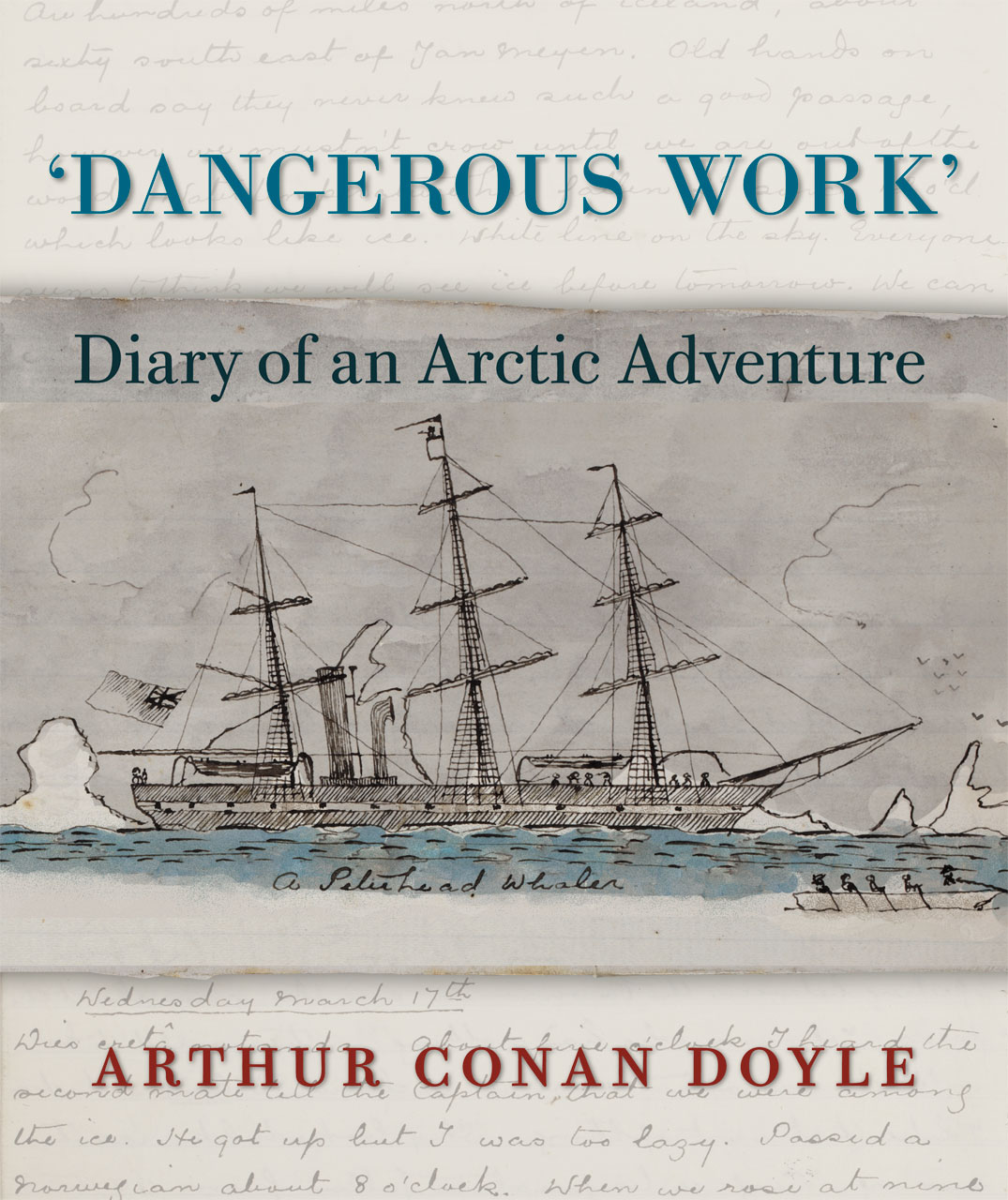
 Arthur Conan Doyle: Dangerous Work: Diary of an Arctic Adventure (1880 / 2012)
•
 Arthur Conan Doyle (1859-1930)
Arthur Conan Doyle: Dangerous Work (2012)
[Bookmark, Devonport - 9/12/2022]:
Arthur Conan Doyle. Dangerous Work: Diary of an Arctic Adventure. 1880. Ed. Jon Lellenberg & Daniel Stashover. Chicago & London: The University of Chicago Press, 2012.

The NY Times reviewer is quick to point out the resemblance between this early, hitherto unpublished journal by Sir Arthur Conan Doyle and Herman Melville's Moby-Dick:
A riddle: What does Captain Ahab have in common with Sherlock Holmes?Lest we should find this a somewhat far-fetched comparison, he goes on to specify in more detail the possible connections with Melville's masterpiece:
Answer: Both characters were created by writers who sailed on whaling vessels, who knew firsthand the heft of a harpoon, the bite of raging gales and the blisters raised by oars.
Herman Melville’s years as a sailor and whaler dominate his work, while for most readers Arthur Conan Doyle’s time at sea is either entirely unknown or, at best, something of a mystery. But now that mystery is unveiled, and like the mysteries unraveled by Holmes himself, it is unveiled with elegance and style in Dangerous Work.
A second riddle: What does Dangerous Work have in common with Moby-Dick?I do love that image of reading both books "from cover to cover ... in front of a warm fire." As far as his suggested analogy between the two authors goes, though, I'd have to admit a few reservations.
A few of a hundred possible answers: Both books disguise great depth beneath the cloak of an adventure story. Both offer accounts of what was once a major industry, comparable in relative terms to today’s oil industry. Both should be read from cover to cover, shared with friends and revisited in front of a warm fire. And both, for different reasons, are books to treasure, the kind that kindle and rekindle a love of words and a feeling of irredeemable debt to the men behind them.
- Bill Streever, "Before Sherlock". NY Times (30/13/2012)

After all, another reviewer comments, à propos of the 'copious notes' provided by the journal's two editors: "there's not much about any earlier Arctic expeditions, with the exception of the fictionalized one of Mary Shelley's "Captain Walton" in Frankenstein."
Doyle's journal, like that of Walton, is framed at first with a series of letters home, then quickly moves on to the daily business of the ship.- Russell A. Potter, The Arctic Book Review (5/11/2012)

Herman Melville, Mary Shelley ... I suppose an even more obvious comparison would be with one of Doyle's greatest literary heroes, the master of the mysterious, Edgar Allan Poe himself - either the story "MS. Found in a Bottle" (1833), or the one novel he authored, The Narrative of Arthur Gordon Pym of Nantucket (1838).

Instead, though, I'd like to explore the perhaps less obvious debt that Doyle's imaginative transformation of his arctic experiences - into, in particular, his early short story "The Captain of the Pole-Star" - owes to pioneering adventure-story writer Jules Verne.

Jules Verne. The Adventures of Captain Hatteras. The Extraordinary Journeys. 1864-65. Trans. William Butcher. 2005. Oxford World's Classics. Oxford: Oxford University Press, 2009.For those of you who haven't read it - which will be most people: even those who love and admire Verne's more famous works: Journey to the Centre of the Earth (1864), From the Earth to the Moon (1865), and Twenty Thousand Leagues under the Sea (1869-70) - Verne's early novel The Adventures of Captain Hatteras (1864-65) may come as a bit of a surprise.

The second in the sequence of fifty-odd "Extraordinary Voyages" which occupied Verne's energies between 1863 and his death in 1905, Captain Hatteras has never enjoyed the renown of such novels as Five Weeks in a Balloon (1863), which kicked off the series in the first place, or even The Children of Captain Grant (1867-68), translated as "In Search of the Castaways", with its scenes of turbulent frontier life in New Zealand, amongst other places.
Perhaps this neglect may partly be due to the strangely obsessive nature of the feud between the mysterious Captain Hatteras and his brash American counterpart Captain Altamont. The resemblances between Hatteras and English explorer Sir John Franklin, who perished with his entire crew when their two ships, the Erebus and Terror, were caught in the ice in 1845, were a bit too close for comfort for British readers, in particular.

As I discussed in my post on the TV miniseries based on the subject, The Terror (2018), there's strong evidence that Franklin's crew were forced to resort to cannibalism in their final flight from the icebound ships, and this made it a rather controversial subject for Victorian mythologists of the glamour of the frozen north. So many relief expeditions were eventually sent in search of Franklin, that far more ships and men were lost looking for him than died in his own party.
Hatteras, a polar monomaniac, himself dies by plunging into the crater of the active volcano which marks the exact location of the North Pole - in the original draft of the novel, that is. Verne's editor, the publisher of the Voyages Extraordinaires, Jules Hetzel, forced him to moderate this into a case of incurable insanity which leaves Hatteras wandering disconsolately around the walls of the asylum in which he is housed, his feet drawn always, inexorably, northwards.


He went off the grating with a dull, sullen splash, and as I looked into the green water I saw him go down, down, down until he was but a little flickering patch of white hanging upon the outskirts of eternal darkness. Then even that faded away, and he was gone.How does this compare with Doyle's own story? I'm fortunate enough to own a copy of the 1893 'colonial' edition of the collection in which it first appears, and have just been rereading it in those time-creased pages. Doyle's Captain Craigie is less distant and uncommunicative than Verne's Captain Hatteras, but he seems every bit as driven and determined in his pursuit of a will-o'-the-wisp.- Arthur Conan Doyle, "The Captain of the Pole-Star" (Temple Bar, 1883)
In Craigie's case it's the ghost of his dead fiancée, a young lady who died "under circumstances of peculiar horror" on the Cornish Coast (perhaps the terrible case of poisoning recorded in the Sherlock Holmes story "The Devil's Foot"?); in Hatteras' case it's simply the renown of being first at the North Pole, but both take absurd risks to attain their particular fata morgana. And, for both, the adventure proves disastrous.

Wilkie Collins' play "The Frozen Deep", adapted and performed by Charles Dickens and his friends in 1856, probably provides the prototype for this motif of the lost beloved drawing men further and further into the Arctic snows.
In Dickens' case, of course, it also brought about his first meeting with the young actress Ellen Ternan, whose fate would be so strangely bound up with his for the rest of his life.

•
 Brian Staite: Function follows Funambulist (2006)
•
 Nicola Holmes: Brian Staite and Jo Straker (1991-92)
Antarctic Cape Sculptures: 'Ice Flow" (2006)
[Masterworks, Auckland CBD, 10/10/26]:
[Paperclay sculptures based on boxes and cans of food left outside the huts of Scott and Shackleton on Ross Island.]
 Natalie Robinson: Antarctic research not all boring work (22/9/2008)
l-to-r: Brian Staite, Dr Andy Mahoney & Dr Mike Williams
Function Follows Funambulist
Shifting poles for an instant, I'd like now to turn your attention to our closer neighbour, Antarctica. I've already written quite extensively about this, a piece called "The Great White Silence" (2012) about Antarctic literature in general, followed by posts about Roland Huntford views on Captain Scott; varying accounts of Douglas Mawson, and Craig Harrison's Antarctic novel Days of Starlight (1988).
I've recently added a new bookshelf devoted entirely to the subject of Polar exploration (with a particular emphasis on the quest for the South Pole). You can find a list of its contents here. The recent addition of three sculptures from Antarctic veteran Brian Staite's Ross Island Huts series to our collection here at home has prompted me to add the following list of books and authors to the more general remarks recorded above:
- Roald Amundsen (1872-1928)
- Richard E. Byrd (1888-1957)
- Apsley Cherry-Garrard (1886-1959)
- Matthew Henson (1866-1955)
- Sir Edmund Hillary (1919-2008)
- Frank Hurley (1885-1962)
- David Lewis (1917-2002)
- Bill Manhire (1946- )
- Douglas Mawson (1882-1958)
- Fridtjof Nansen (1861-1930)
- Robert E. Peary (1856-1920)
- Robert Falcon Scott (1868-1912)
- Ernest Shackleton (1874-1922)
- Francis Spufford (1964- )
- Frank Worsley (1872-1943)
- Amundsen, Roald. My Life as an Explorer. London: William Heinemann, 1927.
- Huntford, Roland. Scott and Amundsen. 1979. A Weidenfeld Paperback. London: Weidenfeld & Nicolson, 1993.
- Huntford, Roland, ed. The Amundsen Photographs. London: Hodder & Stoughton, 1987.
- Huntford, Roland. Race for the South Pole: The Expedition Diaries of Scott and Amundsen. London: Continuum International Publishing Group, 2010.
- Byrd, Admiral Richard E. Alone. 1938. Queen Anne Press. London: Macdonald & Co., 1987.
- Vol. 1
- Vol. 2
- Cherry-Garrard, Apsley. The Worst Journey in the World: Antarctic 1910-1913. 1922. Foreword by George Seaver. 1965. Introduction by Paul Theroux. Picador Travel Classics. London: Pan Macmillan Ltd., 1994.
- Henson, Matthew A. A Black Explorer at the North Pole. 1912. Preface by Robert E. Peary. Introduction by Booker T. Washington. Introduction by Susan A. Kaplan. Bison Books, Lincoln & Nebraska: University of Nebraska Press, 1989.
- Hillary, Edmund, & Vivian Fuchs. The Crossing of Antarctica: the Commonwealth Trans-Antarctic Expedition, 1955-58. 1958. Harmondsworth: Penguin, 1960.
- Hillary, Edmund. Nothing Venture, Nothing Win. London: Hodder & Stoughton, 1975.
- Hurley, Frank. Argonauts of the South: Being a Narrative of Voyagings and Polar Seas and Adventures in the Antarctic with Sir Douglas Mawson and Sir Ernest Shackleton. The Knickerbocker Press. New York: G. P. Putnam’s Sons, 1925.
- Antarctic Eyewitness: Charles F. Laseron’s South with Mawson & Frank Hurley’s Shackleton’s Argonauts. 1947 & 1948. Introduction by Tim Bowden. 1999. Sydney: Angus & Robertson, 2000.
- Murphy, Shane. South with Endurance: Shackleton’s Antarctic Expedition 1914-1917. The Photographs of Frank Hurley. Ed. Tamiko Rex. Foreword by Joanna Wright. 2001. Sydney: Allen & Unwin, 2014.
- Lewis, David. Ice Bird: The First Single-Handed Voyage to Antarctica. 1975. Glasgow: Fontana/Collins, 1977.
- Manhire, Bill, ed. The Wide White Page: Writers Imagine Antarctica. Wellington: Victoria University Press, 2004.
- Vol. 1
- Vol. 2
- Mawson, Douglas. The Home of the Blizzard: The Story of the Australasian Antarctic Expedition, 1911-1914. 1915. Abridged Popular Edition, 1930. Adelaide: Wakefield Press, 1996.
- Mawson, Douglas. Mawson’s Antarctic Diaries. Ed. Fred Jacka & Eleanor Jacka. 1988. North Sydney: Susan Haynes / Allen & Unwin, 1991.
- Day, David. Flaws in the Ice: In Search of Douglas Mawson. Melbourne & London: Scribe Publications Pty Ltd., 2013.
- Vol. 1
- Vol. 2
- Huntford, Roland. Nansen: The Explorer as Hero. London: Duckworth, 1997.
- Reynolds, E. E. Nansen. 1932. Harmondsworth: Penguin, 1949.
- Herbert, Wally. The Noose of Laurels: The Discovery of the North Pole. 1989. London: Grafton Books, 1991.
- Scott, Captain Robert F. The Voyage of the ‘Discovery’. 1905. Cheap Edition. London: John Murray, 1929.
- Huxley, Leonard, ed. Scott’s Last Expedition. 2 vols. Vol I: Being the Journals of Captain R. F. Scott. Preface by Clements R. Markham. Macmillan’s Empire Library. London: Macmillan & Co., Limited, 1913.
- Huxley, Leonard, ed. Scott’s Last Expedition. 2 vols. Vol II: Being the Reports of the Journeys and the Scientific Work undertaken by Dr. E. A Wilson and the Surviving Members of the Expedition. Macmillan’s Empire Library. London: Macmillan & Co., Limited, 1913.
- Evans, Admiral Sir Edward R. G. R. South with Scott. With 31 Photographs by Herbert Ponting. London: Collins, n.d.
- Hooper, Meredith. The Longest Winter: Scott's Other Heroes. 2010. London: John Murray (Publishers), 2011.
- Ponting, Herbert G. The Great White South, or With Scott in the Antarctic: Being an Account of Experiences with Captain Scott’s South Pole Expedition and of the Nature Life of the Antarctic. Introduction by Lady Scott. 1921. London: Duckworth & Co, 1924.
- Shackleton, Sir Ernest. The Heart of the Antarctic: Being the Story of the British Antarctic Expedition, 1907-1909. 1909. Popular Edition. London: William Heinemann, 1910.
- Shackleton, Sir Ernest. South: The Story of Shackleton’s 1914-1917 Expedition. 1919. London: William Heinemann, 1921.
- Shackleton, Sir Ernest. South: The Story of Shackleton’s Last Expedition, 1914-1917. 1919. Ed. Peter King. London: Century Ltd., 1991.
- Shackleton, E. H., ed. Aurora Australis. 1908-09. Introduction by Mary P. Goodwin. Auckland: Seto Publishing , 1988.
- Fisher, Margery & James. Shackleton. Drawings by W. E. How who served with the Endurance Expedition. 1957. London: Barrie Books Ltd., 1957.
- Huntford, Roland. Shackleton. London: Hodder & Stoughton, 1985.
- Joyce, Ernest E. Mills. The South Polar Trail: The Log of the Imperial Trans-Antarctic Expedition. Introduction by Hugh Robert Mill. London: Duckworth, 1929.
- Marr, Scout, of the Quest Expedition. Into the Frozen South. 1923. London: Cassell & Co., 1923.
- Tyler-Lewis, Kelly. The Lost Men: The Harrowing Story of Shackleton’s Ross Sea Party. London: Bloomsbury, 2006.
- Spufford, Francis. I May Be Some Time: Ice and the English Imagination. London: Faber, 1996.
- Worsley, Commander F. A. Under Sail in the Frozen North. Preface by Grettir Algarsson. London: Stanley Paul & Co., Ltd., 1927.
- Worsley, F. A. Shackleton's Boat Journey. The Nautilus Library, 19. 1931. London: Philip Allan & Co., n.d.
- Worsley, F. A. Shackleton's Boat Journey. 1931. Narrative Introduction by Sir Edmund Hillary. New York: W. W. Norton, 1977.
- Worsley, Frank. First Voyage in a Square-Rigged Ship. 1938. London: Geoffrey Bles, 1947.
- Thomson, John. Shackleton's Captain: A Biography of Frank Worsley. 1999. St Leonards, NSW: Allen & Unwin, 1999.
- Day, David. Antarctica: A Biography. A Knopf Book. Sydney: Random House Australia Pty Ltd, 2012.
- Fleming, Fergus. Barrow's Boys. 1998. London: Granta Books, 1999.
- McGoogan, Ken. Fatal Passage: The Untold Story of John Rae, the Arctic Adventurer Who Discovered the Fate of Franklin. 2001. A Bantam Book. London: Transworld Publishers, 2002.
- Niven, Jennifer. The Ice Master: The Doomed 1913 Voyage of the Karluk. Macmillan. London: Macmillan Publishers Ltd, 2000.
- Williams, Glyn. Voyages of Delusion: The Search for the Northwest Passage in the Age of Reason. 2002. London: HarperCollins Publishers, 2003.

Authors:

Roald Engelbregt Gravning Amundsen (1872-1928)
Rear Admiral Richard Evelyn Byrd, Jr. (1888-1957)
Apsley George Benet Cherry-Garrard (1886-1959)
Cherry-Garrard, Apsley. The Worst Journey in the World: The Story of Scott’s Last Expedition to the South Pole. 1922. 2 vols. London: Penguin, 1937.
Matthew Alexander Henson (1866-1955)
Edmund Percival Hillary (1919-2008)
James Francic [Frank] Hurley (1885-1962)
David Henry Lewis (1917-2002)
Bill Manhire (1946- )
Douglas Mawson (1882-1958)
Mawson, Sir Douglas. The Home of the Blizzard: The Story of the Australasian Antarctic Expedition, 1911-1914. 2 vols. London: William Heinemann, 1915.
Fridtjof Wedel-Jarlsberg Nansen (1861-1930)
Nansen, Fridtjof. Farthest North: Being the Record of a Voyage of Exploration of the Ship Fram, 1893-96, and of a Fifteen Months' Sleigh Journey by Dr. Nansen and Lieut. Johansen, with an Appendix by Otto Sverdrup, Captain of the Fram. 2 vols. Westminster: Archibald Constable and Company, 1897.
Robert Edwin Peary (1856-1920)
Robert Falcon Scott (1868-1912)
Ernest Henry Shackleton (1874-1922)
Francis Spufford (1964- )
Frank Arthur Worsley (1872-1943)


•
- category - Scottish: Authors
•


